EICR Codes Explained: What C1, C2, C3 & FI Mean
Updated: Sep 2
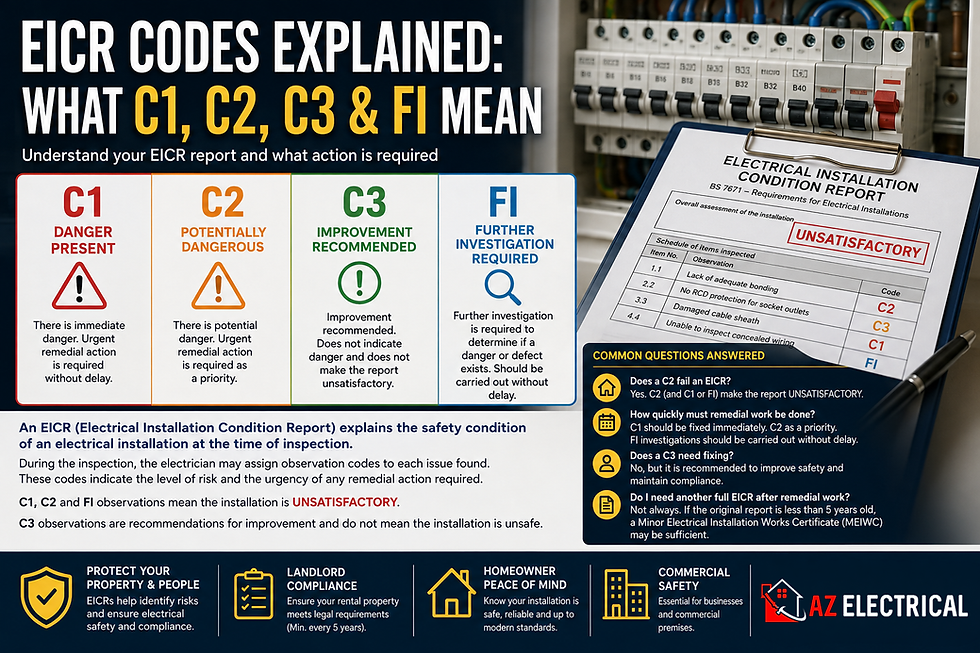
If your Electrical Installation Condition Report contains a C1, C2, C3 or FI code, the code tells you the seriousness of the electrical observation and what should happen next. C1 means danger is present, C2 means a potentially dangerous condition has been identified, C3 means an improvement is recommended, while FI means further investigation is advised or required depending on the version of BS 7671 being used.
Understanding those differences matters because the codes do not all have the same effect on an EICR.
A C1 or C2 is significantly more serious than a C3 recommendation. FI also deserves particular attention in 2026 because an important change to BS 7671 has altered how it affects the overall result of an EICR.
For homeowners, landlords and businesses in London, the most useful approach is therefore to understand both the classification code and the actual electrical observation recorded alongside it.
⬛ EICR Codes at a Glance
C1 — Danger Present: An immediate electrical danger has been identified and remedial action is necessary.
C2 — Potentially Dangerous: The condition is not necessarily causing immediate danger at that moment, but it presents a potential safety risk and urgent remedial action is necessary.
C3 — Improvement Recommended: Improving the installation is recommended, but a C3 does not by itself make the EICR unsatisfactory.
FI — Further Investigation: Something identified during inspection or testing needs additional investigation before a proper conclusion can be reached.
Under the previous BS 7671 Amendment 3 framework, C1, C2 and FI could result in an unsatisfactory EICR. Under Amendment 4:2026, C1 and C2 affect the overall assessment, while C3 and FI are advisory classifications and do not themselves make the overall report unsatisfactory.
What Is an EICR?
EICR stands for Electrical Installation Condition Report.
It is a formal inspection and test of an existing electrical installation designed to assess whether that installation is in a satisfactory condition for continued use.
The inspection is concerned primarily with the fixed electrical installation rather than whether individual appliances happen to work. Depending on the premises and agreed extent of the inspection, this can include wiring, consumer units or distribution boards, circuits, socket outlets, lighting circuits, protective devices, earthing and bonding arrangements and other fixed electrical equipment.
The electrician records inspection and test results and identifies observations requiring attention. Those observations are then assigned classification codes such as C1, C2 or C3, while FI can be used where further investigation is appropriate.
An EICR is therefore much more than a pass-or-fail certificate.
It gives the person responsible for the property structured information about the condition, safety and future requirements of the electrical installation.
🟥 C1 — Danger Present
A C1 is the most serious EICR classification.
It means the inspector has identified danger at the time of the inspection and immediate remedial action is necessary.
The issue is not simply that the installation could theoretically be safer. There is an existing condition capable of creating an immediate risk of electrical injury.
Depending on the circumstances, an inspector may need to make a C1 condition safe before leaving the property. Making something safe does not always mean carrying out the complete permanent repair there and then, but an immediate danger should not simply be left accessible.
Examples could include circumstances where dangerous live parts are exposed and capable of being touched. However, EICR classifications should always be based on the actual installation and circumstances rather than homeowners attempting to assign codes from examples found online.
If your report contains a C1, treat it as an immediate electrical safety issue.
C2 — Potentially Dangerous
A C2 means a potentially dangerous condition has been identified and urgent remedial action is necessary.
This is different from C1 because immediate danger may not be present at the exact time of inspection.
However, the condition is sufficiently serious that it could lead to electric shock, fire or another electrical safety problem under foreseeable circumstances.
Examples discussed within electrical-industry guidance can include certain defects involving protective measures, earthing, bonding or protection against electric shock.
The correct classification depends on the specific installation and the conditions found during inspection and testing.
A C2 makes an EICR unsatisfactory.
This is important because homeowners sometimes look at an installation where every light and socket appears to work and assume a C2 cannot be serious.
Electrical safety does not work that way.
A circuit can continue operating perfectly normally while containing a defect that reduces the protection available if something goes wrong.
🟥 Does a C2 Mean My Electrics Have Failed?
In practical terms, a C2 means the EICR is unsatisfactory.
It does not necessarily mean the whole electrical installation is dangerous at every point, and it certainly does not automatically mean the property requires complete rewiring.
It means one or more potentially dangerous conditions have been identified and require urgent remedial attention.
For example, one particular circuit or protective arrangement could require work while the majority of the installation remains in good condition.
The correct response is therefore to read the individual observation, understand why the electrician assigned C2 and establish what remedial work is needed.
Do not translate:
"Unsatisfactory EICR"
automatically into:
"The entire house needs rewiring."
They are not the same thing.
C3 — Improvement Recommended
A C3 means improvement is recommended.
This is a fundamentally different classification from C1 or C2 because a C3 does not by itself mean the installation is unsafe for continued use.
Electrical standards evolve.
An installation completed many years ago may not contain every safety measure that would be expected in an equivalent new installation today. That does not mean every older electrical installation automatically becomes dangerous whenever BS 7671 changes.
The IET specifically explains that standards are not retrospective. An installation that complied with an earlier edition of BS 7671 is not necessarily unsafe merely because newer requirements have subsequently been introduced.
A C3 therefore allows an inspector to recommend an improvement without categorising the condition as an immediate or potential danger.
Does a C3 Make an EICR Unsatisfactory?
No.
A C3 does not by itself make an EICR unsatisfactory.
This is one of the most common areas of confusion when property owners receive an electrical report.
An EICR might contain several C3 observations and still receive a satisfactory overall assessment, provided there are no classifications affecting that result under the version of BS 7671 being used.
That does not mean C3 recommendations are pointless.
Improving the installation could increase safety, improve protection or bring an aspect of the installation closer to modern standards.
The difference is urgency.
A C3 is a recommendation for improvement rather than a classification saying danger or potential danger is present.
⬛ OLD DOES NOT AUTOMATICALLY MEAN UNSAFE
This is worth emphasising because it prevents a lot of unnecessary concern.
An older consumer unit, older cable installation or electrical system installed under previous regulations does not automatically require replacement merely because newer standards now exist.
The inspector assesses the actual safety condition.
Where an older feature still provides an acceptable level of safety, it should not automatically receive a C2 classification simply because something newer is available.
Where upgrading would improve safety but the existing condition is not dangerous or potentially dangerous, a C3 may be more appropriate depending on the circumstances.
EICR coding should therefore reflect risk, not simply age.
What Does FI Mean on an EICR?
FI stands for Further Investigation.
It is used where inspection or testing has revealed something that cannot be properly concluded without additional investigation.
Imagine a test result indicates that something is not behaving as expected, but the cause cannot be confirmed during the agreed periodic inspection.
The electrician should not simply guess.
Further investigation can then be used to establish the cause and determine whether another defect or safety problem exists.
It is important to understand that periodic inspection and testing is intended to assess the electrical installation's condition. It is not necessarily an unlimited fault-finding exercise.
Electrical Safety First's Best Practice Guide 4 specifically covers the appropriate use of C1, C2, C3 and FI classifications.
🟥 IMPORTANT 2026 CHANGE TO FI
This is where older EICR advice found online can now be misleading.
BS 7671:2018+A4:2026 was published on 15 April 2026.
During the six-month transition period until 15 October 2026, electricians can carry out EICRs to either the previous Amendment 3 framework or Amendment 4, provided the correct standard and forms are used.
Under Amendment 3, an FI classification affects the overall outcome and results in an unsatisfactory report.
Under Amendment 4, FI has changed to "Further investigation is advised" and is grouped alongside C3 observations. FI no longer automatically makes the EICR unsatisfactory.
From 15 October 2026, Amendment 4 becomes the current standard for EICRs as the previous version is withdrawn.
That means if you receive an EICR containing FI during this transition period, it is worth checking which version of BS 7671 the report has been produced to.
What Makes an EICR Unsatisfactory?
Under the new Amendment 4 EICR format, the classifications that affect the overall assessment are:
C1 — Danger present
and:
C2 — Potentially dangerous
A report containing either classification will be unsatisfactory.
C3 and FI are recorded separately as advisory observations and do not affect the overall assessment under Amendment 4. The official Amendment 4 model EICR explicitly separates the C1/C2 observations that affect the assessment from the C3/FI observations that do not.
During the transition period, however, an EICR completed under Amendment 3 continues to treat FI differently.
This is why an online article that simply says:
"FI always fails an EICR"
or:
"FI never fails an EICR"
is incomplete in 2026.
The standard stated on the actual report matters.
Do C1 or C2 Codes Mean I Need a Full Rewire?
No, not automatically.
An unsatisfactory EICR can sometimes be corrected through relatively targeted remedial work.
For example, an electrician may identify an issue affecting one circuit, one protective device, a particular connection, part of an earthing or bonding arrangement or another defined part of the installation.
In other cases, an installation may contain numerous significant defects or extensive deterioration, making larger-scale electrical work more sensible.
The key is to look at the observations and test results, not merely the word "unsatisfactory".
A qualified electrician should be able to explain what needs correcting and why.
If somebody looks at a single C2 code and immediately tells you every cable in the property must be replaced, ask them to explain how the observation leads to that conclusion.
What Happens After EICR Remedial Work?
Once the required work has been completed, the electrician should provide appropriate documentation for that work.
You do not automatically need another complete EICR every time remedial work is undertaken.
The correct documentation depends on the work carried out and could include an Electrical Installation Certificate, Minor Electrical Installation Works Certificate or other appropriate electrical certification.
For landlords in England, current government guidance expressly recognises a satisfactory EICR, EIC, Minor Electrical Installation Works Certificate or other suitable electrical certification as possible written confirmation that required work has been completed.
The important thing is to create a clear record:
Original EICR identifies the issue → remedial work is completed → appropriate certification confirms the work.
Keep those documents together.
London Landlords and EICRs
Landlords have additional responsibilities because electrical safety requirements apply to rented properties in England.
Current government guidance requires landlords covered by the regulations to have fixed electrical installations inspected and tested by a qualified person at least every five years, or sooner where the previous report requires an earlier inspection.
Existing tenants must normally receive a copy of the report within 28 days of the inspection. New tenants must receive the report before occupying the property, and landlords must retain the report for the next inspection.
Where the report shows that remedial work or further investigative work is necessary, the government guidance requires landlords to complete it within 28 days or any shorter period specified in the report. Written confirmation of completion must subsequently be provided as required.
Because FI treatment is changing within BS 7671 during 2026, landlords should follow the specific report they receive and the qualified inspector's written requirements rather than assuming that every FI observation has identical consequences.
⬛ LANDLORD EICR CHECKLIST
When you receive an EICR, do not only look for the word satisfactory.
Read the observations and check whether the report contains C1, C2, C3 or FI classifications. Understand what work is required, whether an issue needs immediate attention, what timescale has been specified and when the next periodic inspection is due.
Keep the original report together with any subsequent electrical certificates or written confirmation of remedial works.
For rented properties in England, remember that five years is a maximum standard interval, not a guarantee that every EICR lasts for exactly five years. The inspector can specify an earlier next-inspection date where appropriate.
What Does an EICR Actually Inspect?
An EICR is concerned with the fixed electrical installation.
In a typical residential property that can include the consumer unit, fixed wiring, socket circuits, lighting circuits, protective devices, earthing arrangements and bonding.
The inspection may look for signs of deterioration, damage, overheating, inappropriate alterations, inadequate protective measures and other conditions that could affect electrical safety.
Electrical testing then provides information that cannot necessarily be discovered by looking at the installation.
This is why an electrical installation can appear perfectly normal to a homeowner while still producing important observations during an EICR.
Common EICR Issues
Every property is different, and a particular observation should never be pre-classified without inspecting the installation.
However, periodic inspections can reveal issues involving areas such as earthing and bonding, damaged equipment, inadequate protection, deteriorated wiring, unsuitable alterations or other conditions affecting electrical safety.
Older London properties can also contain electrical work completed at very different times.
A single house may include original wiring, later extensions, a kitchen refurbishment, new circuits, old circuits and alterations made by several previous owners.
That does not automatically make the electrical installation unsafe.
But it does make proper inspection and testing valuable because appearance alone cannot establish the condition of every circuit.
🟥 AN EICR IS NOT A TEST OF WHETHER THE LIGHTS WORK
This is another important distinction.
A socket can provide electricity while still containing a safety defect.
A lighting circuit can operate normally while testing reveals a problem with the protective measures.
A consumer unit can appear tidy while the wider installation contains issues elsewhere.
The purpose of an EICR is therefore not to confirm:
"Everything turns on."
It is to assess:
"Is the fixed electrical installation in a satisfactory condition for continued use?"
Those are very different questions.
Can Two Electricians Give Different EICR Codes?
There can be differences in professional judgement, but classification should not be arbitrary.
BS 7671 provides the reporting framework, while established industry guidance such as Electrical Safety First's Best Practice Guide 4 exists to promote consistency between inspectors.
The electrician needs to consider the defect, the available protective measures and the actual degree of danger.
It is not enough to say:
"This does not comply with the latest regulations, therefore it is C2."
Older installations do not automatically become unsafe because regulations have changed.
Equally, something should not receive a harmless C3 classification if the actual circumstances make it potentially dangerous.
The inspector should be able to explain the reasoning behind the classification.
Can I Challenge an EICR Code?
You can certainly ask the inspector to explain it.
A good EICR observation should make it possible to understand:
What has been identified?
Where is it?
What is the safety concern?
Why has that classification been assigned?
If you are unsure, ask for the reasoning in plain English.
Where there is a genuine dispute about technical classification, an independent competent electrician experienced in inspection and testing may be able to review the installation and report.
What you should not do is choose whichever code produces the cheapest outcome.
Electrical classifications exist to communicate risk.
What About Plastic Consumer Units?
This is an excellent example of why internet EICR advice can become oversimplified.
Modern domestic installations generally use consumer units with non-combustible enclosures where the relevant requirements apply.
However, the existence of an older plastic consumer unit does not automatically mean the EICR must be unsatisfactory.
Electrical Safety First's current Best Practice Guide specifically includes examples where the presence of combustible consumer-unit material does not, on its own, automatically warrant a classification code in certain circumstances.
The inspector considers factors such as the condition, location, evidence of thermal damage and the overall circumstances.
Again:
Older ≠ automatically dangerous.
Does No RCD Automatically Mean C2?
Not necessarily.
RCD protection has expanded significantly through successive versions of BS 7671.
A modern installation may require RCD protection in circumstances where an older installation legitimately did not when originally installed.
Classification therefore depends on the actual risk, the circuit, how it is used, the protective measures available and the circumstances of the installation.
Some situations involving absence of appropriate additional protection can warrant a C2. Other situations may result in a C3.
This is precisely why EICR coding should be carried out by somebody competent in inspection and testing rather than generated from a universal online table.
Homeowners: Should You Get an EICR?
EICRs are not solely for landlords.
A homeowner may choose an EICR where the installation has not been inspected for a long period, where there are concerns about previous electrical alterations or when they want a clearer understanding of the fixed wiring's condition.
It can also be useful before major renovations because the results may influence decisions about rewiring, consumer-unit work or additional circuits.
An EICR can help separate:
Electrical work that is genuinely required for safety
from:
Electrical improvements that may simply be desirable.
That can be valuable when planning a refurbishment budget.
Buyers and Sellers
Homebuyers may also consider electrical inspection where the age or apparent condition of the installation raises concerns.
A normal home survey is not the same as an EICR and does not involve the same electrical inspection and testing.
For a buyer, an EICR can provide more detailed information about the fixed electrical installation before or after purchasing a property.
For sellers, addressing significant electrical defects before marketing or completion can sometimes reduce uncertainty during a transaction.
The important point is not that every home sale legally requires an EICR — it does not — but that specialist electrical inspection can provide information that a general property survey does not.
EICRs for Commercial Properties
The same fundamental classification system can be used on commercial EICRs, but the installations themselves may be considerably more complex.
Commercial premises can include three-phase supplies, several distribution boards, extensive lighting, fixed machinery, data infrastructure, commercial kitchens, offices, warehouses and large numbers of circuits.
The consequences of poor electrical reliability may also be greater because a fault can affect employees, customers, operations or business continuity.
Commercial inspection and testing should therefore be planned around the actual site rather than treated as a larger version of a domestic certificate.
The person responsible for the installation should clearly understand the observations, their classifications and the work required afterwards.
What Should I Do With an Unsatisfactory EICR?
Start with the observations.
If the report contains a C1, immediate safety action is required.
If it contains a C2, urgent remedial action is required.
If it contains FI, determine which version of BS 7671 the report has been completed to and what further investigation the inspector has identified.
If it contains C3, consider the recommended improvement and whether it should be incorporated into planned electrical work.
Ask the electrician for a clear scope of remedial work and make sure the correct certification is produced afterwards.
For landlords, follow the statutory timescales applying to the property.
For homeowners and businesses, deal with significant safety defects promptly rather than filing the EICR away because the electrical installation still appears to work normally.
🟥 DON'T JUST ASK "DID IT PASS?"
Ask:
What was found?
What is dangerous?
What is potentially dangerous?
What is simply recommended?
What needs investigating?
What work should happen next?
That gives you a much better understanding of the installation than the word satisfactory or unsatisfactory on its own.
Professional Electrical Inspection and Testing in London
AZ Electrical provides residential and commercial electrical services throughout London, including electrical inspection and testing, fault finding, installation work and remedial electrical services.
An EICR should leave you with a clearer understanding of your electrical installation rather than a page of unexplained codes.
Where observations are identified, understanding the difference between C1, C2, C3 and FI makes it much easier to decide what needs immediate attention, what requires urgent remedial work and what can be considered as a future improvement.
You can view AZ Electrical's electrical services or contact AZ Electrical to discuss inspection, testing or electrical remedial work for a London property.
Frequently Asked Questions About EICR Codes
What Does C1 Mean on an EICR?
C1 means danger present. There is an immediate electrical safety concern and remedial action is necessary.
What Does C2 Mean on an EICR?
C2 means potentially dangerous. Urgent remedial action is necessary and the classification makes the EICR unsatisfactory.
What Does C3 Mean on an EICR?
C3 means improvement recommended. It does not by itself make the EICR unsatisfactory.
What Does FI Mean on an EICR?
FI means further investigation. Under Amendment 4:2026 the wording is further investigation is advised, and FI does not itself affect the overall EICR outcome.
Does a C1 Fail an EICR?
Yes. A C1 affects the overall assessment and results in an unsatisfactory EICR.
Does a C2 Fail an EICR?
Yes. A C2 indicates a potentially dangerous condition requiring urgent remedial action and results in an unsatisfactory report.
Does a C3 Fail an EICR?
No. A C3 is a recommendation for improvement and does not by itself make the EICR unsatisfactory.
Does FI Fail an EICR?
It depends on the BS 7671 version used for the report. Under Amendment 3, FI affects the outcome and can make the EICR unsatisfactory. Under Amendment 4:2026, FI does not affect the overall satisfactory or unsatisfactory assessment.
Why Has FI Changed?
Amendment 4 separates observations that determine whether an installation is satisfactory — C1 and C2 — from advisory C3 and FI observations. The IET explains that this helps return FI to its intended role where further investigation is genuinely appropriate.
When Does Amendment 4 Become Mandatory?
BS 7671 Amendment 4 was published on 15 April 2026. The previous Amendment 3 version remains current during the transition until 15 October 2026, after which Amendment 4 becomes the current standard for EICRs.
Do C3 Codes Have to Be Fixed?
A C3 does not normally need to be corrected for an EICR to receive a satisfactory outcome. It represents an improvement recommendation.
Does an Unsatisfactory EICR Mean I Need a Rewire?
No. The required work depends on the individual defects recorded. Some unsatisfactory EICRs can be resolved through specific remedial work without rewiring the entire property.
Can an Old Consumer Unit Automatically Receive a C2?
No. Age alone does not determine the EICR classification. The inspector assesses the actual safety condition and circumstances.
Does the Lack of an RCD Always Mean C2?
No. The correct classification depends on the installation, circuit, use and level of risk. Some circumstances can warrant C2 while others may result in C3.
How Often Do Landlords Need an EICR?
For rented properties covered by the regulations in England, electrical installations must generally be inspected and tested at least every five years, or earlier where the previous report specifies a shorter interval.
How Long Does a Landlord Have to Complete EICR Remedial Work?
Current government guidance says required remedial or further investigative work must normally be completed within 28 days, or sooner where the report specifies a shorter period.
Does a Landlord Need Another Full EICR After Repairs?
Not automatically. Appropriate electrical certification or written confirmation can be used to demonstrate completion of remedial work depending on what has been carried out.
Can an EICR Contain Several Different Codes?
Yes. One report can contain C1, C2, C3 and FI observations where appropriate.
Can an EICR Be Satisfactory With C3 Codes?
Yes. C3 recommendations do not themselves make the overall EICR unsatisfactory.
Can an EICR Be Satisfactory With FI?
Under Amendment 4:2026, yes. FI does not affect the overall assessment. Under the previous Amendment 3 framework, FI is treated differently, which is why the standard shown on a 2026 report should be checked.
Who Should Carry Out an EICR?
Inspection and testing should be carried out by somebody competent to undertake that work. For regulated rented properties, government guidance refers to a qualified person competent to carry out the inspection and testing.
What Is BS 7671?
BS 7671 is the British Standard containing the Requirements for Electrical Installations, commonly known as the IET Wiring Regulations.
Sources and Further Reading
This article provides general information about EICRs and electrical classification codes. Electrical classifications should be determined by a competent person using the actual installation, inspection findings and test results. During the 2026 BS 7671 transition period, check which version of the standard is stated on the individual report.
⬛ About the Author
Aaqil Zeyad is the owner of AZ Electrical Engineering Services Ltd, a London-based residential and commercial electrical contractor providing electrical installation, inspection and testing, fault finding, security, networking and associated electrical services.
AZ Electrical works with homeowners, landlords and businesses throughout London and surrounding areas, helping customers understand the condition of their electrical installations and complete appropriate electrical work where defects or improvements are identified.


Comments